

The Still Studio 🪞
A practice in creative clarity — where I build the systems, frameworks, and workflows I wish I'd had sooner.
0.1 The spark
The Still Studio started in conversation with ChatGPT — a tool I used to think more clearly, and eventually, to rebuild how I work.
I wasn't trying to build a brand. I was trying to understand my own burnout.
Those early sessions became a space to ask questions I hadn't slowed down to ask in years — about clarity, purpose, and what it means to do work that feels alive.
Out of that, frameworks started to form. Prompts. Systems. Structure that didn't feel rigid.
I realized I could design clarity itself — not as a buzzword, but as a practice.
That's how The Still Studio was born: part self-reflection, part design experiment. A collaboration between intuition and iteration.
0.2 Ethos and reason why
Everything I've built here comes from navigating career pivots and burnout — learning to work with less noise, more intention, and systems that actually hold up.
AI became the amplifier.
It helped me organize my thoughts, spot patterns in my creative habits, and turn what I was learning into something others could use.
What I've found is this: when you work with AI clearly — not defensively, not blindly — it becomes a way to see your own thinking from a new angle, prototype faster, and reconnect with what makes your work yours.
That's what The Still Studio is for. To show what's possible when clarity leads.
0.3 The challenge
Most creatives don't struggle with talent — they struggle with structure.
They have more ideas than systems, more inspiration than direction.
I wanted to build something that moves people from creative noise to creative clarity.
The Still Studio became my way of testing a question:
Can AI and content design help creators think more clearly, work more sustainably, and make decisions they actually trust?
0.4 The system
I built The Still Studio around three tools. Each one addresses a different part of the creative process.
Content
Purpose
A guide for creatives navigating burnout and uncertainty. Walks you through grounding exercises, AI-assisted prompts for focus, and a framework for turning personal experience into a sustainable offer. Includes decision-making tools, energy management practices, and validation exercises.
A short book about building a creative practice rooted in presence, not pressure. Explores the role of pausing, observation, and pleasure in the creative process — plus practical rituals using soundscapes, warm light, and intentional routines.
A custom AI assistant that helps you plan projects, organize ideas, and keep momentum without overstructuring. Think of it as a creative project manager that adapts to how you work.
Format
PDF, created on Canva
PDF, created on Canva
Open AI-powered assistant
Together, they form a clarity loop: awareness → focus → creation → flow.
I built The Still Studio by treating it like a content design project — researching the problem, prototyping solutions, and iterating based on what actually worked.
Research
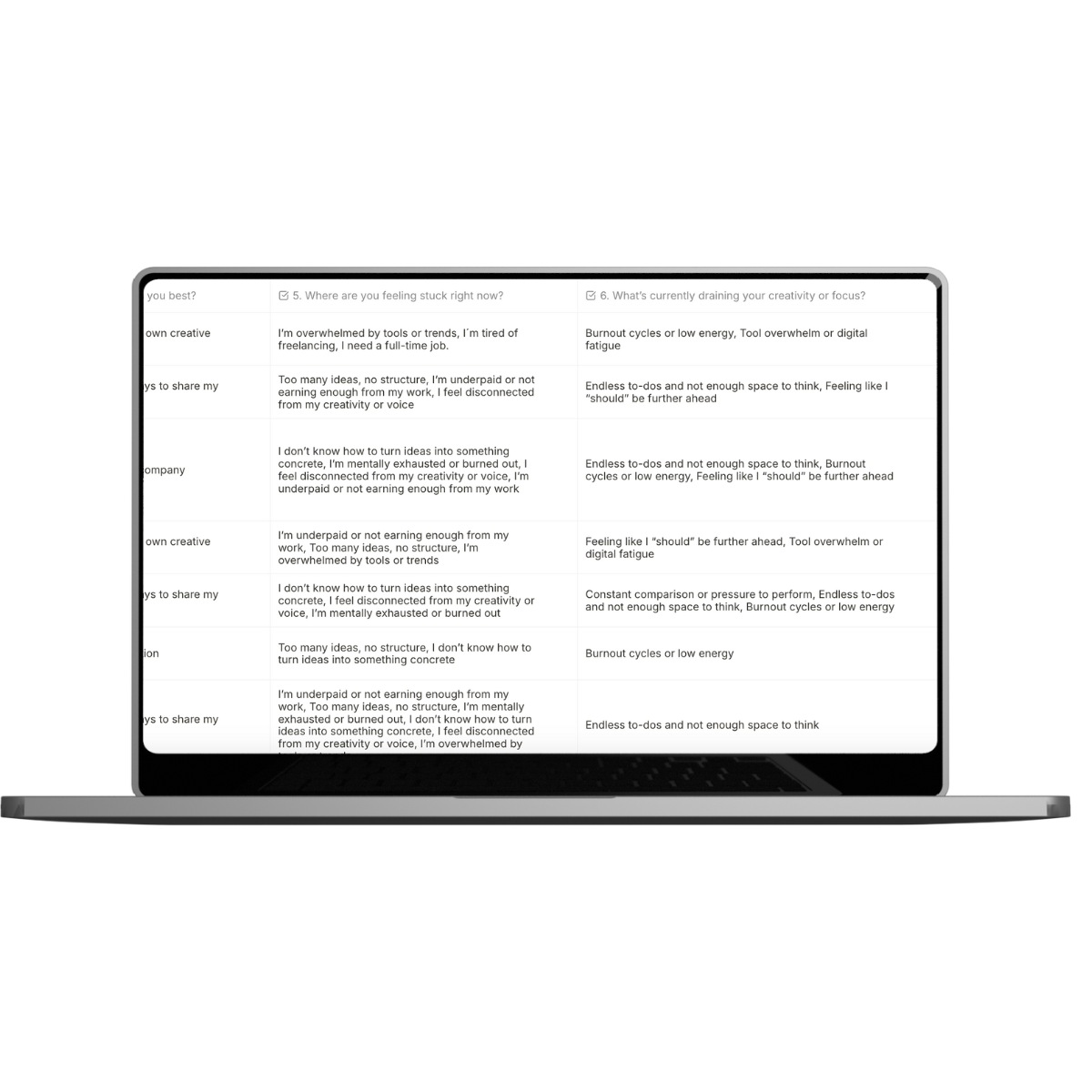
I surveyed and interviewed over 30 creative professionals — UX writers, designers, illustrators, and marketers — to understand where creative work breaks down.
The common patterns: too many ideas, no structure, and a tendency to burn out before things take shape.Prototyping with AI
I used ChatGPT to build and test frameworks, exercises, and decision-making prompts. Each tool was designed to help people move from overwhelm to action — without adding more pressure.The Clarity Toolkit walks users through grounding practices, AI-assisted focus prompts, and a step-by-step framework for turning experience into an offer.
The Art of Creating explores the role of presence, pleasure, and ritual in creative work — with practical tools like soundscapes, energy management, and intentional routines.
Voice & tone
The voice is calm, editorial, and direct. It doesn't motivate or inspire — it clarifies. Short paragraphs, natural rhythm, no hype.Visual identity
The design mirrors the content: soft colors, generous space, minimal distraction. Everything serves clarity, not decoration.
0.5 The process
0.6 The results
I shared The Still Studio quietly — a few Instagram posts, a small email list, and word of mouth.
Within the first week:
50+ downloads of the Clarity Toolkit (English and Spanish versions)
40%+ engagement rate on Instagram (saves + new followers)
First Gumroad sales came in organically, with no paid marketing
The feedback was immediate. People described the work as "clear," "grounding," and "unexpectedly human."
One user wrote:
"I downloaded your guide. I loved it. I'm using your advice — the app is helping me when my energy drops. I used to think it could support my creative process. The pauses help me step out of the neighborhood and give myself 'air' for my thoughts. I really like the approach. I deeply believe in the creative process and respecting your own rhythm."
What stood out: the tools worked because they didn't add pressure. They created space.
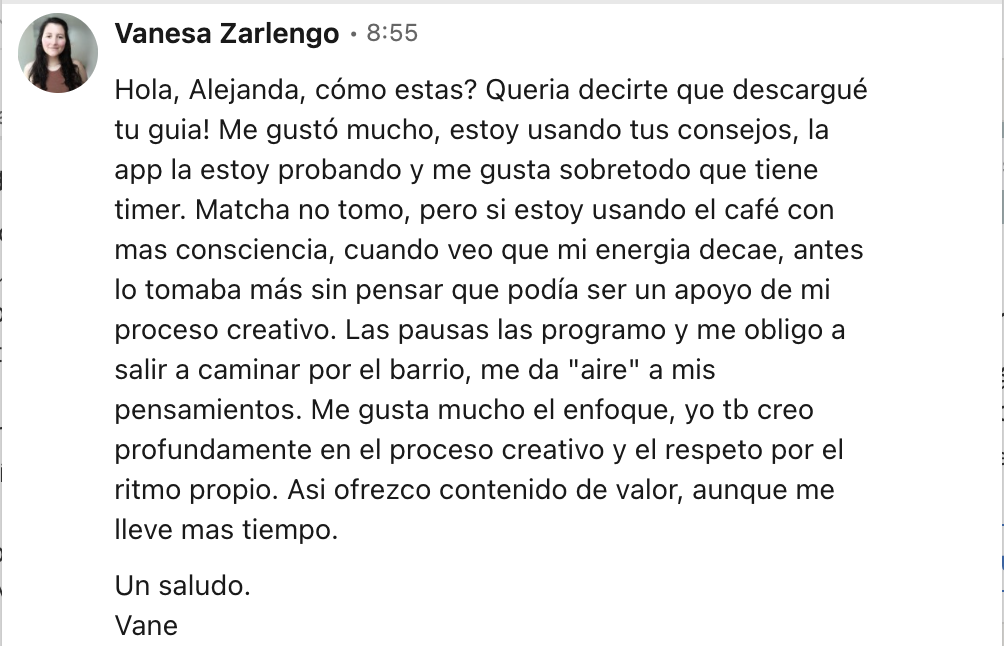
Review, LinkedIn message
0.7 What I learned
Building The Still Studio taught me that clarity is both a creative and operational skill.
AI helped me move faster — but more importantly, it helped me see my own thinking. The act of writing prompts forced me to articulate what I wanted, why it mattered, and how to explain it simply.
I also realized that content design and creative wellbeing aren't separate practices. Both are about building systems that help people make decisions, stay focused, and trust their own process.
The more intentional I was with the AI, the clearer the output became. And the clearer the output, the easier it was to refine my own voice.
What surprised me most: the tools people found most useful weren't the most polished. They were the ones that felt human — grounded in real experience, not productivity theater.
0.8 What’s next
The Still Studio is growing into a small ecosystem:
Gumroad hosts the guides and toolkits.
Instagram is where I test ideas, share frameworks, and build in public.
FORMA GPT helps people organize projects, plan their weeks, and stay focused without overstructuring.
Right now, I'm working on:
A short course on using AI for content clarity (without the hype)
More frameworks for freelancers navigating positioning and pricing
The question I'm holding: How can AI help creatives build sustainable practices — not just faster output?